

If you’re specifying product inspection equipment for a food processing line in Australia, you’re likely asking yourself the same question a lot of operators do: do you need a food x-ray machine, a metal detector, a checkweigher, or a combination of all three?
Getting the technology right is what keeps you compliant.
This blog walks through what each technology food and beverage instrumentation equipment detects (and doesn’t), the contaminant types you’re potentially dealing with and how to think about combining technologies for compliance.
What each instrumentation equipment detects
Metal detection
Metal detection equipment detects ferrous, non-ferrous, and stainless steel contaminants passing through the aperture.
It’s fast, reliable, and well understood across the industry – but it’s blind to anything that isn’t metal.
Glass, stone, dense plastic, bone, and calcified product fragments will all pass straight through a metal detector undetected. That’s where you need x-ray inspection.
X-ray inspection
X-ray product inspection equipment in food processing images the product based on density differences.
It can pick up a much broader range of contaminants – metal, glass, stone, dense plastics, rubber, and calcified bone – as well as verify things metal detection can’t touch at all, like missing product, incorrect fill levels, or damaged packaging (crushed cans, broken product, clumping).
The trade-off is that very low-density contaminants – some plastics, hair, or lightweight organic material – can still be difficult to distinguish from the product itself, particularly in dense or irregular products.
Checkweighing
Checkweighing doesn’t detect contaminants, it verifies weight.
An underweight product is a compliance and labelling issue (and in many jurisdictions, a legal one), while an overweight product is not correctly costed.
Checkweighers are commonly integrated with metal detection or x-ray units as a combined system, using the same conveyor and control platform to report on weight and contamination.
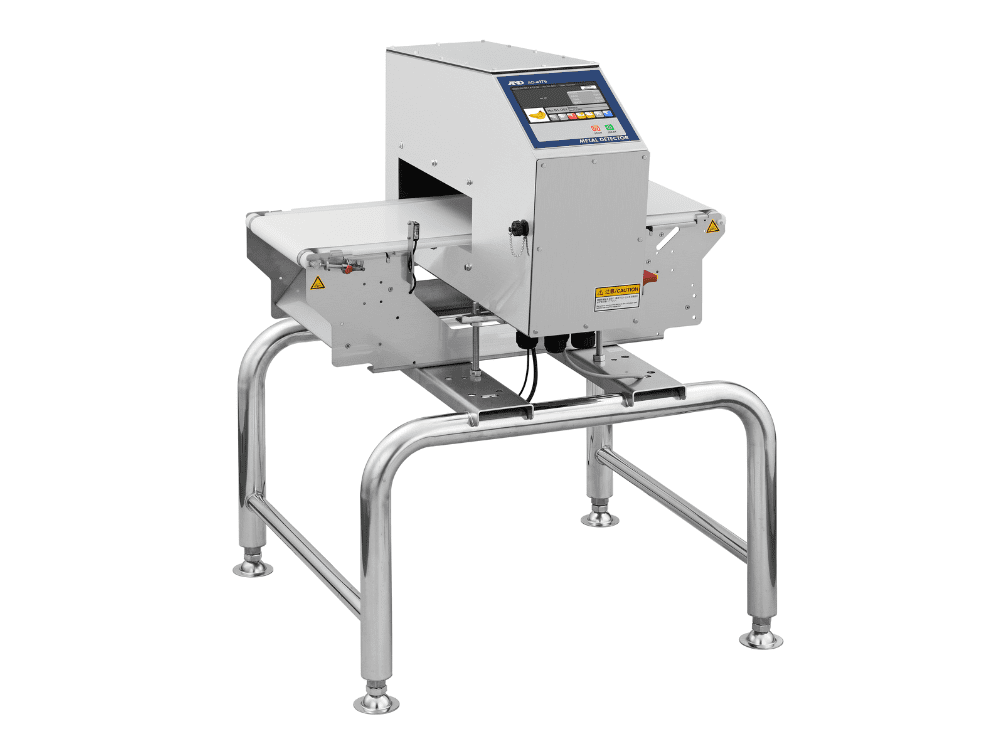
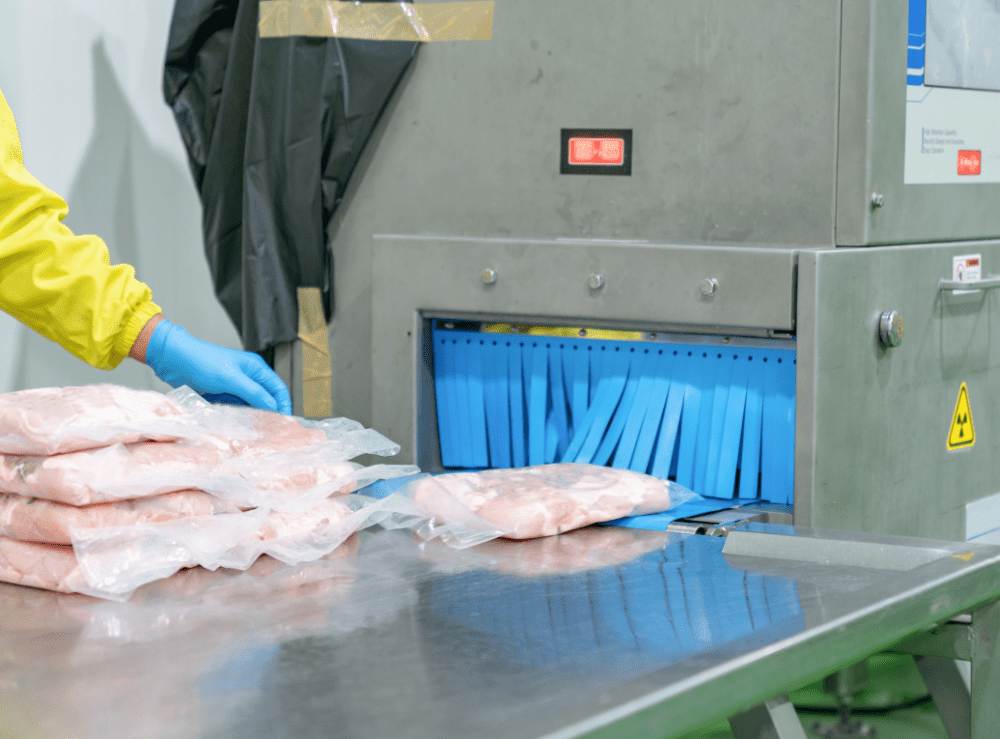
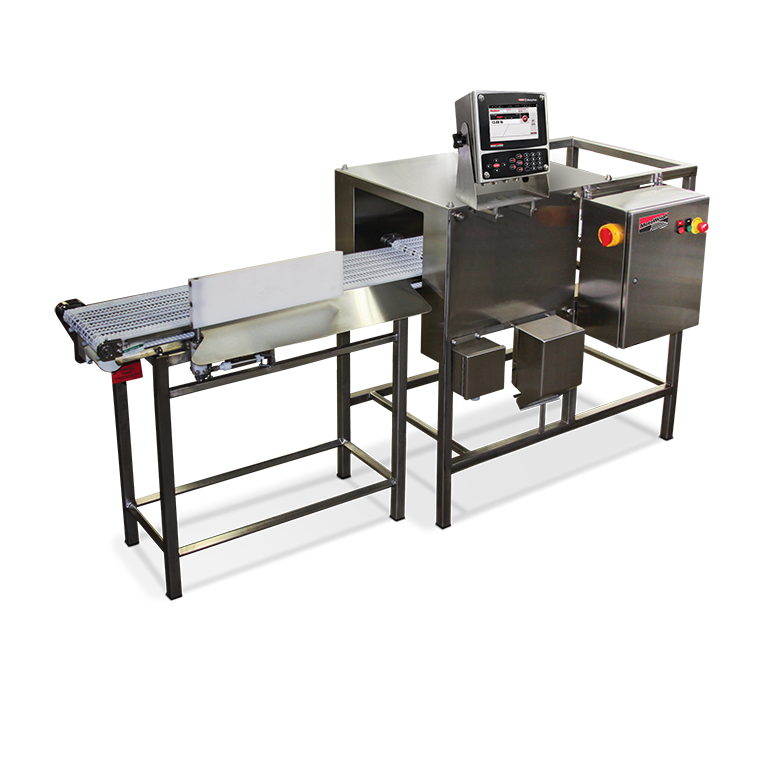
Overall, metal detection instruments catch metal quickly, x-ray catches a much wider range of physical contaminants and verifies pack integrity, and checkweighing protects your business on weight compliance and product giveaway.
Contaminant types by material
Choosing between the right food inspection equipment gets a lot more concrete once you consider what you’re likely to find in your product.
Here is a list of the type of material, what to look for and what equipment to use.
|
Type of material |
What to look for |
What equipment to use |
|
Ferrous and non-ferrous metal |
Wire, tramp metal, fragments from processing equipment. |
Reliably caught by metal detection, also caught by x-ray. |
|
Stainless steel |
Caught by metal detection and by x-ray. |
|
| Glass |
Caught by x-ray product inspection equipment based on density contrast. |
|
|
Stone and mineral contaminants |
Caught by x-ray. |
|
|
Calcified bone and cartilage |
X-ray can detect it, though sensitivity depends on the density of the bone relative to the surrounding product – a known challenge in meat and poultry processing. |
|
|
Dense or rigid plastics |
PVC and PET fragments. |
Caught by x-ray, but again dependent on density contrast against the product. |
|
Low-density plastics, rubber, and organic contaminants |
Hair, insects, some soft plastics. |
The hardest category for any single technology – this is often where visual inspection or upstream process controls do more of the work than automated detection.
|
Where each technology sits on the line
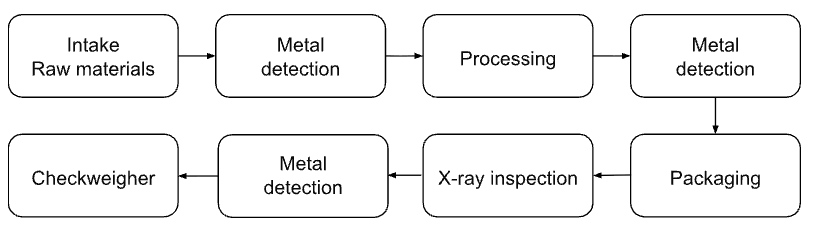
The right layout depends on your specific line, product format, and the number of intervention points you have space and budget for – but as a general pattern, metal detection is placed early, while x-ray and checkweighing typically consolidate at the point of final pack verification.
Combining food inspection equipment for compliance
Very few food processing sites run on a single technology alone, because most compliance frameworks (food safety plans, and customer-specific quality controls) expect a documented critical control point analysis that identifies your contaminant risks.
In practice, this usually means:
- Metal detection at one or more points to manage the most common and highest-likelihood contaminant (metal from processing equipment).
- Food x-ray machines at the point of final inspection, where it catches the broader range of physical contaminants and doubles as pack integrity and fill verification.
- Checkweighing integrated at the same point, so weight compliance is verified without adding a separate machine.
Where budget or line space limits you to one technology, the decision comes down to your documented risk assessment.
If metal is your only credible contaminant risk, metal detection alone may satisfy your food safety plan. If your risk profile includes glass, stone, dense plastics, or pack integrity concerns – which covers most retail and export-facing finished products – x-ray is generally the stronger single-technology choice. It is the closest thing to a checkweighing, metal detection and x-ray system in one unit.
Validation and record-keeping
Whichever combination of food processing technologies you integrate will need strong validation and record-keeping, as this is where your auditors and customers are focused.
At minimum, you’ll need this documentation:
1. SENSITIVITY TESTING:
Documented sensitivity testing using certified test pieces appropriate to your product and contaminant risk.
2. FAILED TESTING RESPONSE:
A documented response procedure for what happens on a failed test – including escalation if a unit fails validation.
3. CALIBRATION AND MAINTENANCE RECORDS:
Documentation showing the equipment is being serviced and checked against manufacturer specifications.
4. AUDIT TRAIL:
That ties test records, reject data, and corrective actions together – most modern x-ray and metal detection units log this automatically, but the process for reviewing and filing it still needs to be defined and followed.
What are the most common failed audit procedures in food processing plants?
A food processing plant is an industrial facility where animal materials are processed and packaged into consumable food items.
The two most commonly failed audit procedures in food processing plants in Australia are gaps in test frequency (skipped or undocumented checks), and no clear record of what happened when a test failed or a unit went out of tolerance.
Getting the fit right for your site
The right combination of food x-ray machines, metal detection, and checkweighing across your food processing plant comes down to your specific contaminant risk, product format, packaging, and the compliance framework you’re working to. A proper site and risk assessment, which can be led by one of SRO Technology’s specialist technicians, is needed to determine the right equipment.
Are you ready to understand what best fits your food processing requirements? Get in touch with our technicians for a tailored site assessment. We’ll look at your products, your current risk profile, and your compliance requirements to recommend the right food processing inspection setup, whether that’s a standalone unit or a combined system.
Recent Comments